

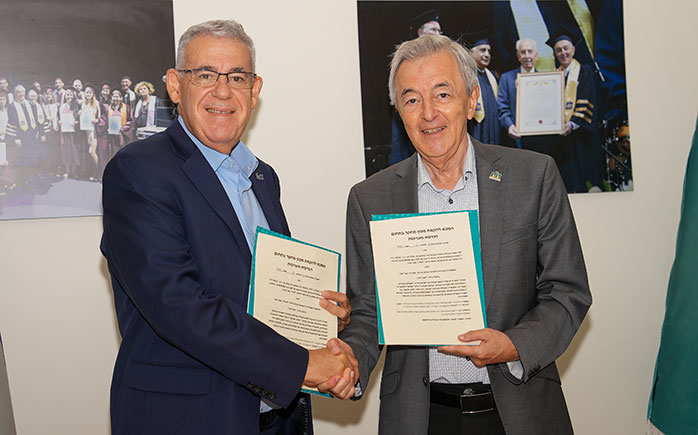
Israel Aerospace Industries (IAI) and HIT Holon Institute of Technology have signed an agreement to establish a joint research institute that will focus on integrating artificial intelligence into development, maintenance, and manufacturing processes in the defense industry. The agreement was signed at a meeting attended by senior IAI management, led by Chairman of the Board Boaz Levy, and senior academic staff from HIT, led by the Institute’s President Prof. Eduard Yakubov. The joint vision for the institute’s activity in the coming years was presented during the meeting.
“Precious Time That Demands Change”
The meeting was opened by Prof. Yakubov, who presented the institute’s departments, its ties with industry, its senior faculty, and the range of students studying at HIT, and gave the guests an overview of the academic and research activity taking place at the institute, including its newly established research centers.
IAI Chairman Boaz Levy emphasized that the current situation requires a profound shift, both in thinking and in action, across Israel’s defense industries and that academia is required to support this process as well. According to him, the war that broke out on October 7th sharpened several key insights: the need to change engineering education methods, a significant shift in the approach to time-to-market given customers no longer willing to wait long delivery periods, and the urgent need to develop independent cloud capabilities and technological infrastructure that would strengthen the resilience and technological independence of Israel’s defense industries.
The Chairman also presented IAI’s financial results for the first half of 2026: revenues exceeding $8 billion, net profit of about $1 billion, and an order backlog of $35 billion. He noted that behind these figures lies a central question – who does the work, and what is required of today’s and tomorrow’s engineers and technicians.
A significant part of his remarks was devoted to how engineering itself has changed from an independent, separate field into one that goes hand in hand with manufacturing, robotics, and large-scale management, that requires an approach rooted in curiosity and creativity. He gave the example of a 3D-printing project for a space product, in which a veteran, experienced engineer approached the design based on knowledge and experience accumulated over the years, while a young engineer who came straight from academia and had already been exposed during his studies to advanced methods and technologies approached the same task from a different angle and proposed an innovative solution that was lighter and better suited to the printing technology. According to Levy, the example illustrates the value of connecting the experience and knowledge accumulated in industry with the fresh thinking that comes from academia, and the importance of cultivating curiosity, creativity, and open thinking among the next generation of engineers.
He went on to elaborate on the shift in mindset required of engineers in the AI era: whereas in the past, developing an aircraft wing required many iterations of wind-tunnel testing, involving substantial time and resources, today the use of AI capabilities, data, and advanced simulation tools makes it possible to significantly streamline the development process and reduce the number of iterations required. He said that alongside professional engineering knowledge, the engineer of the future will need, more than ever, integrative ability, creative thinking, and curiosity capabilities that academia can cultivate already during studies, alongside providing the professional and technological tools future engineers will need.
He also recalled two major decisions the company made since October 7: shifting to round-the-clock operations to fully meet the needs of the defense establishment, alongside maintaining full compliance with commitments to the company’s customers around the world, with no delays in deliveries. He said the ability to operate on both fronts simultaneously strengthened customer trust in IAI and appreciation for the company and for the State of Israel. He further emphasized that engineering excellence and the ability to develop advanced, efficient, and competitive solutions are a key factor in IAI’s continued growth in international markets.
The Academic Vision
Later in the meeting, the academic vision for the joint research institute was presented. According to Prof. Michael Vinokur, HIT’s academic lead for the initiative, the profession of the systems engineer the ability to view systems from above and connect disciplines that have no obvious link between them is a profession that will not disappear, and one that artificial intelligence is not expected to replace. Nevertheless, the institute aims to train the systems engineer of the future to use AI as a thinking-support tool: to streamline development processes, reduce faults, and save engineers from tedious tasks that previously required considerable time and effort.
The head of research at the joint institute is Dr. Avital Shrift of IAI, who will lead the institute’s ongoing research activity.
As part of the agreement, IAI has committed to sending at least six employees each year to the master’s degree program in systems engineering at HIT. This year, three employees have already begun the program, despite joining relatively late in the academic calendar.
To manage the collaboration, a joint steering committee will be established, comprising representatives of both organizations. The committee will convene three times a year — at the beginning, middle, and end of the year — to discuss budgets, research goals, and results achieved.
Closing Remarks
The meeting concluded with closing remarks from both sides, emphasizing the mutual importance of the partnership. The Institute’s President summed up by saying that HIT’s educational approach seeks to encourage students to think not only “outside the box,” but entirely without one — and to always ask “why.” For its part, IAI expressed hope that the collaboration would deepen in the coming years, driven by a sense of shared purpose that extends beyond the formal agreement signed today. The visit concluded with a tour of the Faculty of Design’s graduate exhibition, which left a strong impression on the guests.
Participants from HIT
Participants from IAI


