

A familiar way to picture the challenge behind his research is a traffic jam that appears out of nowhere. When one driver on a crowded highway brakes slightly and the next brakes a little harder, the reaction ripples backward until traffic stands still with no obstacle ahead. Each driver makes a simple decision yet understanding how all those decisions affect one another is much harder.
Physicists face a similar challenge with large numbers of interacting quantum particles, where knowing the laws of individual interactions does not easily explain the behavior of the whole system. Tall uses random matrix theory, a mathematical approach that uncovers statistical patterns across complex systems to reveal the bigger picture without working out every detail.
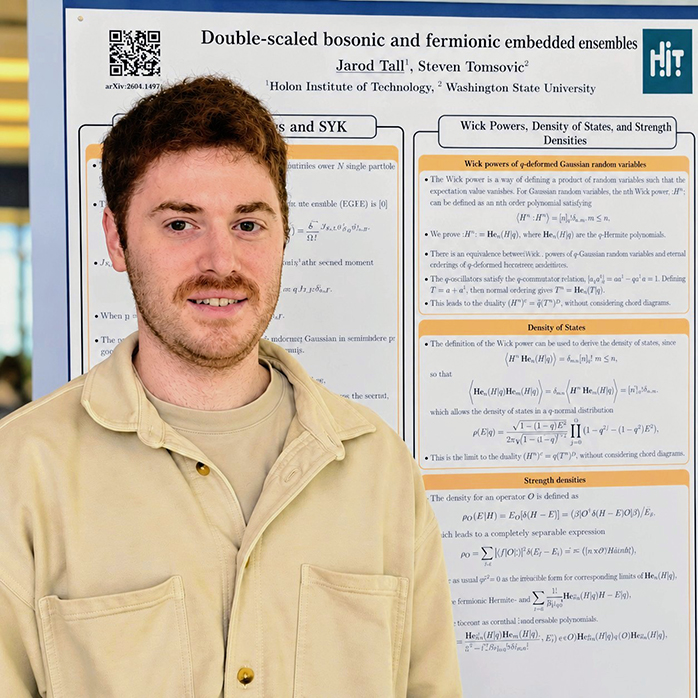
In his joint work with Prof. Steven Tomsovic, Tall investigated interacting models of bosons and fermions — the two main types of quantum particles. Although these particles follow different rules, the researchers showed that, under specific mathematical conditions, their models can be described using the same mathematics as Sachdev-Ye-Kitaev (SYK) models. These models are also used to explore connections between quantum physics and gravity.
Tall completed his doctorate in physics at Washington State University under Prof. Tomsovic’s supervision and recently joined HIT’s School of Mathematical Sciences, where he works with Prof. Eugene Kanzieper on research in random matrix theory funded by the Israel Science Foundation.


