

There is one moment small and almost invisible that defines the daily life of millions of people living with Parkinson’s disease and similar neurological conditions: the moment when the leg simply refuses to move. It isn’t weakness, and it isn’t pain. It’s Freezing of Gait, a phenomenon in which the brain issues the command, but the body seems to stick to the floor. That split second is often what stands between a safe step and a fall.

Adi Yotvat, a recent graduate of the Industrial Design Department, knows this moment intimately not from professional literature, but from home. SenStep, her final-year project, is a smart wearable system born out of personal experience, with a single goal: to give people with Parkinson’s their next step.
“The starting point for the project is my father, “Yotvat says. Her late father lived with MSA (Multiple System Atrophy), a neurological disease in the Parkinson’s family. Over the years, she accompanied him closely and watched his walking become progressively less safe.
“I was exposed up close to his difficulties walking, to the repeated falls, and to the way his lack of confidence in movement gradually eroded his independence,” she recounts. What began as a difficult family experience gradually became a professional question: how can design and technology respond to the most vulnerable moment in a person’s walk?
Out of that struggle, Yotvat undertook in-depth research into Parkinson’s disease, its physiology, the daily challenges it creates, and the existing (and missing) solutions on the market.
That is how the drive to develop a solution was born one that would help preserve independence and confidence in movement, not only for her father, but for everyone facing the same phenomenon.
SenStep is not designed for the most advanced stages of the disease. It is intended precisely for those in a particularly delicate position: people in the early-to-moderate stages of Parkinson’s, who still walk and function independently but live under the constant fear of the next fall.
This is exactly the population for whom every freezing episode is not just a physical obstacle, but also a blow to self-confidence. Fear of falling often leads people to proactively limit their activity and stop leaving the house, which accelerates the decline of independent function, a cycle the system is designed to break.
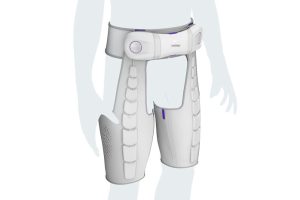
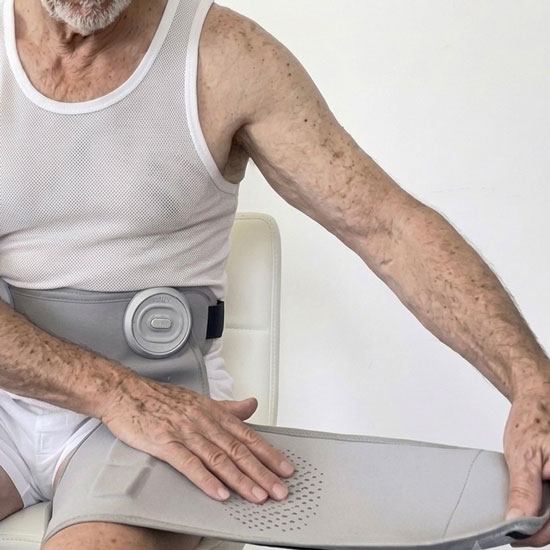
At the core of SenStep lies an idea that is simple to explain but complex to implement: the system continuously monitors the user’s gait pattern and muscle activity. When it detects signs of an approaching or occurring freezing episode, it delivers a short, precisely timed mechanical assist to hip flexion exactly the action needed to “release” the leg and enable the next step.
The system does not attempt to replace the user’s natural gait, and it is always not active. It engages only when it is needed, supporting the execution of the next step and helping the user return to a stable walking sequence then receding into the background again, unnoticed.
The Design Challenge
One of the most fascinating parts of the project isn’t the technology itself, but its outer form. Yotvat chose not to take the obvious route of “yet another tech garment,” and instead developed an entirely dedicated cut one that isn’t worn like ordinary pants but is specifically tailored to the way the target population gets dressed and to their everyday needs.
This decision wasn’t purely aesthetic. For people whose walking and movement are already compromised, the act of getting dressed itself can be a non-trivial task. The cut Yotvat developed allows the three complex technological components of the system’s smart textile, sensors, and the actuation mechanism, to be integrated comfortably, stably, and discreetly, without sacrificing comfort, freedom of movement, or everyday ease of use.
In other words: the system isn’t meant only to “work” on a technical level, but also to feel like a natural article of clothing, something a person can live in — not cumbersome medical equipment that reminds the user at every moment that they are “sick.”
SenStep is far more than a design exercise. It is a project that presents a new line of thinking both design-driven and technological for confronting one of the most challenging and dangerous phenomena Parkinson’s patients face. It raises questions about the potential of discreet wearable systems capable of detecting subtle changes in movement and providing precise assistance at exactly the moment it’s needed no sooner, no later.
Behind every sensor, every stitch, and every line of the cut lies a personal story: of a daughter who watched her father struggle for every step, and chose to turn that pain into a tool that can help others hold on to the very thing the disease tries to take from them first their independence.
Project supervisor: Prof. David Rawet
Adi was awarded a certificate of excellence and a scholarship for the project.


