

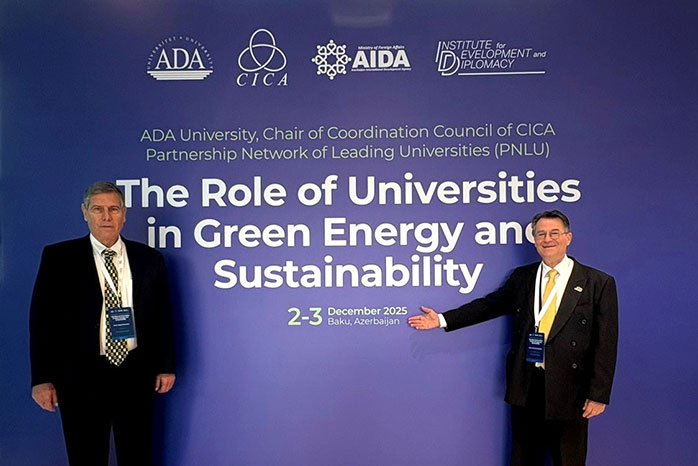
The conference, attended by representatives from Azerbaijan, Uzbekistan, Kazakhstan, China, South Korea, Iran, India, Japan, Pakistan, Iraq, Jordan, Israel, Egypt, Turkey, Bangladesh, and Kyrgyzstan, was held at ADA University in Baku under the theme “The Role of Universities in Green Energy and Sustainable Development,” discussing the acceleration of the green energy transition.
This issue stands at the forefront of the global agenda, as green energy becomes one of the essential components of energy security and nations face growing environmental challenges, particularly climate change, alongside the need to ensure energy security and sustainable economic development. Multilateral platforms, such as the Conference on Interaction and Confidence Building Measures in Asia (CICA), play a crucial role in fostering regional dialogue and cooperation on these issues, contributing to broader goals of peace, security, and sustainable development.

Carbon emissions are a major contributor to global energy-related pollution. One of the primary ways to reduce them is through technologies and accelerating the use of green energy. The conference’s objective was to create a dedicated platform for collaboration among Asian universities on climate change. Topics included green energy, climate change, energy transition, and the shift to sustainable energy. Discussions focused on green energy, energy efficiency, sustainability, green technologies, renewable energy, and inter-university cooperation across the CICA region.
The conference also addressed the following subjects:
The conference concluded with decisions to create policy documents, including recommendations on green energy and sustainability and their regional dimensions within the CICA framework; strengthening academic partnerships among universities from CICA member states; youth and faculty engagement programs for future activities; identifying joint research priorities and capacity building; and defining an action plan for follow-up activities, led by the Chair of ADA University.
Participants included scientists, government members, economists, professors, engineers, architects, climate experts, educators, and social experts.
Prof. Haim Dottan summarized the conference: “Our world faces daily challenges: global energy demands, climate change, regional climate crises, new energy solutions, evolving regulations, international cooperation, and now the revolutionary power of artificial intelligence. We are moving decisively toward sustainable energy sources – solar, wind, hydro, geothermal, and bioenergy, but beyond these systems lies another vital natural resource: Human Energy (HE) – the physical and mental power of humans. Every action generates energy: walking, running, speaking, breathing, physical activity. However, beyond physical energy lies an even more powerful source: consciousness energy – the power of will, focus, imagination, and innovation.

“With eight billion people on Earth, including 1-2 billion young people aged 16-30, the potential of human energy is enormous. By empowering the younger generation through education, creativity, and new technologies, we can reduce global energy consumption, develop new energy solutions, and create healthier living environments worldwide. This is the new vision for future generations.”
The conference was attended by over 50 professors, researchers, experts, and representatives of universities from the 21 CICA member states. It is important to note that this was the first time Israel participated in this conference and that HIT Holon Institute of Technology was the only Israeli academic institution to take part in the conference, where its representatives received considerable positive attention.


