

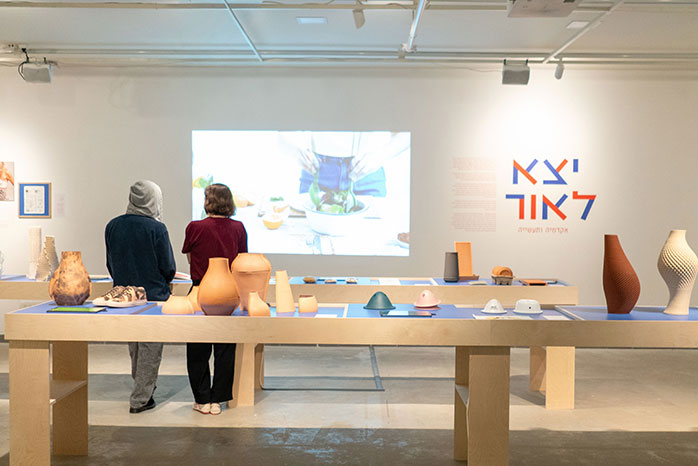
Between an idea born in a studio and a product people buy, there lies a significant gap. The new exhibition featuring graduates of the Faculty of Design at HIT Holon Institute of Technology, places both ends side by side, and what is revealed between them is surprising.
The exhibition “Out in the World,” curated by Faculty Dean Prof. David Rawet and Rona Zinger, is built around a single principle: every project is presented twice – first as it appeared on submission day, and then as it looks today, on a store shelf, in a hospital, or listed on an international e-commerce platform. The space between these two versions is, in essence, the story the exhibition tells.
Prof. Rawet, speaking at the opening evening, quoted the prophet Amos: “Can two walk together, except they be agreed?” One need not reach for lofty literary references to express the connection between design and industry. The close relationship and shared purpose between design, which seeks to bring into being a new reality and industry, which requires design’s work and possesses the knowledge to realize its outputs, dates back to a time before “design” was called design, and when industry was simply a collection of craftsmen.
The Faculty of Design at HIT is committed to embedding this essential relationship into the training of future designers, making collaboration with industry an inherent part of its work.
“Out in the World” is precisely that: academic projects that took on a life of their own whether through direct pathways or through students’ own initiative and made it out into the world, out into the market”.
Here are a few examples:
When Eran Zarhi submitted his Industrial Design final project, Tevaplanter, no one in the room knew he was about to become an entrepreneur behind a crowdfunding campaign raising over six million dollars, with a customer base spanning dozens of countries. The product is a planter in which vegetation grows without soil, through a ceramic system that conducts moisture directly to the roots. It has since become one of the best-selling products of its kind worldwide, with over 200,000 units sold to date.
Not every journey from campus to market runs through a viral campaign. Naama Nicotra chose to tackle a problem the food industry prefers to ignore: the single-use plastic wrapping on nearly everything we put in our cooking pots. Her solution, NakedPak, is packaging you can simply cook with it dissolves in water and leaves no toxic residue. The Israel Innovation Authority is already backing her, and the product is set to reach consumers in the United States within the coming year.
Perhaps the most surprising story in the exhibition, however, belongs to its most understated project. Noa Barda, working in the “Fixperts” course in partnership with Strauss, identified that opening a bag of potato chips, something most people do without a second thought, is a genuine obstacle for anyone limited to the use of just one hand. The change she proposed required no complex technological development, only an adjustment to the way the packaging is cut on the production line. Strauss adopted the solution, and since 2022, all the company’s salted snack products have come in the accessible format.
HIT Holon Institute of Technology has developed, over the years, a studying model in which the connection to industry is not an appendix to the curriculum but a fundamental part of it. For students, this means that even during their studies they are required to contend with real-world constraints clients, production lines, and end users. “Out in the World” shows what happens when it works.


