


Yaron Elyasi, an industrial designer, researcher, and lecturer at HIT Holon Institute of Technology suggests a solution.
Although death is an inseparable part of our life cycle, the way people choose to bury their dead today is far from nature friendly. In a world where available land is steadily running out – especially in small, densely populated countries like Israel – burial, too, is becoming an environmental and ecological crisis: the average grave occupies about 3 square meters, and cemeteries continue to expand at the expense of precious land.
Alongside the land problem, the burial process itself involves enormous consumption of concrete, metals, and energy. In recent years, new models have indeed emerged in Israel, such as high-density burial in multi-story structures, but these too rely on heavy, polluting infrastructure and do not offer a sustainable solution. Against this backdrop, a question arises that sounds almost like science fiction: could the future of burial lie beneath the sea?
By the End of the Century: Tens of Thousands of Dunams will be required for Burial
The burial problem is not unique to Israel; it is part of a worsening global environmental crisis. A report by Earth Funeral, which examined the environmental impacts of various burial methods, points to the vast scale of resources required for traditional burial. According to the report, cemeteries in the United States consume approximately 1.6 million tons of concrete and more than 64,000 tons of steel each year for the construction of graves and burial structures alongside enormous quantities of wood for coffins and roughly 9.5 million liters of embalming fluid.
Moreover, cemeteries themselves require extensive infrastructure development and ongoing maintenance for years. Meanwhile, cremation, considered in many Western countries a solution to the land shortage, consumes large amounts of energy and releases greenhouse gases and other pollutants into the atmosphere, including mercury.
In Israel, the issue takes on particularly complex significance. This is a small, crowded country whose land resources are limited to begin with, yet whose population continues to grow at a relatively high rate compared to many countries around the world. This means that not only is available land shrinking, but the need for burial space is expected to keep growing in the coming decades. According to data from the Knesset Research and Information Center, cemetery expansion comes at the expense of open spaces, leading to habitat loss and cumulative ecological damage. The data further shows that by 2065, Israel will require up to an additional 8,800 dunams (about 2,175 acres) for burial purposes, and by the end of the century, the required area is expected to soar by up to roughly 21,000 additional dunams (about 5,190 acres). For comparison, that is an area several times larger than a small-to-mid-sized Israeli city such as Givatayim.
The Dead Will Give Life to the Marine Ecosystem
A new Israeli patent called Blue Rest offers an original, environmentally friendly solution: modular marine reefs incorporating burial chambers within underwater structures. Although the idea which will be presented at the 54th Annual Conference on Science and the Environment, to be held on July 8–9 at the International Convention Center in Jerusalem sounds futuristic, artificial reefs are already used around the world today to restore marine ecosystems.
Behind the research stands Yaron Elyasi, an industrial designer, researcher, and lecturer at HIT Holon Institute of Technology. The idea began to take shape some 12 years ago, after Elyasi visited cemeteries across the country. “The sight of these cities of the dead and the endless expanses of concrete raised deep questions in me about how we relate to death, to memory, and to the land resources we leave behind,” he recounts, adding: “I left with a heavy feeling. I would prefer that after my death, my presence make some contribution to the system of life, rather than becoming yet another consumer of land.”
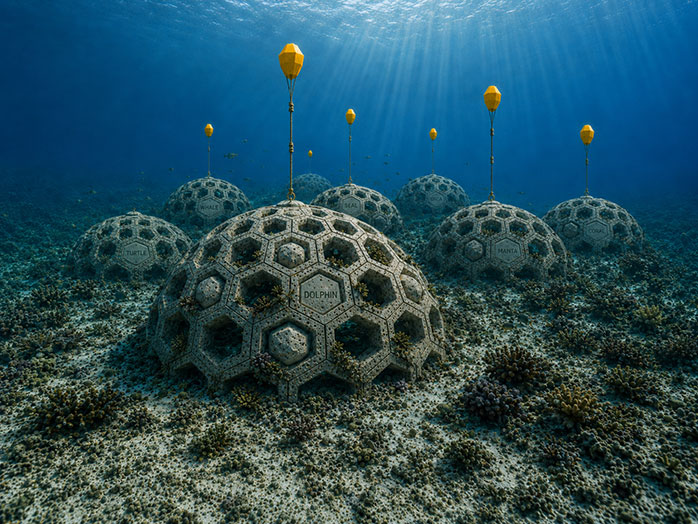
Elyasi’s project offers not merely a technical solution to the land shortage, but an attempt to rethink the very idea of burial and remembrance. Instead of crowded, static, lifeless cemeteries, he envisions a living, dynamic underwater space in which burial becomes part of an active ecosystem. The modular structures he has designed are built as artificial reefs that enable the settlement of marine organisms, the creation of fish habitats, and the renewal of the marine environment. The goal, he says, is to transform death from a process of resource consumption and land occupation into one that generates environmental value. “Instead of leaving behind more concrete and marble, perhaps we can return to the cycle of life in a way that continues to nourish the environment,” he says.
Snorkeling Instead of Visiting a Grave
In contrast to the image of anonymously scattering ashes at sea, the project envisions a physical, marked space of remembrance, in which burial units are integrated into modular underwater reefs. Elyasi emphasizes that for him, the project is not only about ecology, but also an attempt to transform the experience of parting and remembrance itself. Over the years, he says, cemeteries have become “cities of concrete and marble” crowded, alienating spaces that intensify the sense of loss.
“I think about the possibility of going to the sea instead of to a cemetery, standing before the horizon, the water, and the quiet, knowing that beneath you an entire living system is thriving,” he says. “Memory doesn’t have to be tied only to a lifeless stone. It can be part of a living place that changes and renews itself.” Over the years, he says, the reefs are expected to become habitats for fish, corals, and other marine creatures, and visiting the site would be possible through diving or snorkeling an experience he describes as “meditative, and closer to nature than a visit to a traditional cemetery.”
Alongside its ecological potential, the project also raises complex questions concerning religion, regulation, emotional accessibility, and the cultural meaning of a burial place in the age of the climate crisis. As of today, this remains a theoretical research project that has not yet been tested in practice, but Elyasi believes that in a world grappling with land scarcity, ecosystem collapse, and a climate crisis, ideas of this kind may in the future evolve from speculative vision into genuine necessity. He notes that there is already initial interest from researchers and various organizations around the world, and he hopes the research will eventually move from the conceptual stage to practical implementation. “We are used to thinking of death as an absolute end, but in nature there is no real end only the transition from one form of matter to another. Perhaps the time has come for human burial, too, to stop being an environmental burden and start returning to the cycle of life instead of being built against it,” he concludes.


