


Conducted in collaboration with the School of Nursing at Ono Academic College, the study assessed the use of VR-based practice as a tool for supporting learning and procedural comprehension.
As part of the research, an interactive virtual reality simulation was developed by Minerva XR, which operates the XRH Lab at HIT. The simulation replicates a complex medical procedure- urinary catheterization in a female patient with the aim of exploring how immersive technologies can enhance the quality of clinical training for the next generation of nurses in Israel.
Traditionally, nursing students practice clinical skills in simulation laboratories or during hands-on clinical placements in hospitals and clinics. However, opportunities for practice are limited and are often accompanied by anxiety about making real-time errors.
VR technology enables students to practice repeatedly in a safe, controlled environment with no risk to patients while receiving immediate performance feedback. The simulation supports the development of self-confidence, improves procedural accuracy, and deepens experiential learning. Representing Ono Academic College, the study were Dr. Sarit Shimony Kanat,, Dr. Sirat Abu Hamad, Dr. Salam Hadid, and Ms. Michal Yasur.
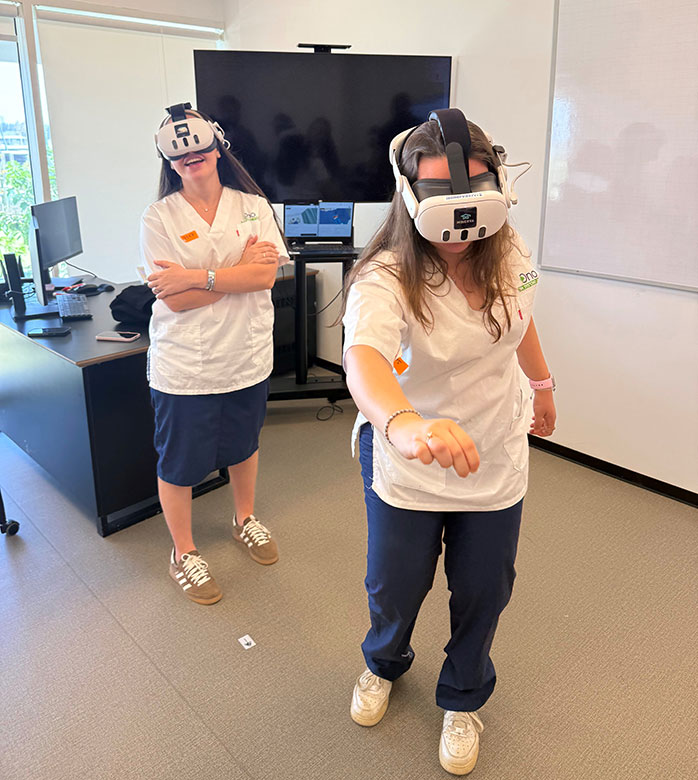
VR technology creates a visually rich, multisensory learning environment that immerses students in a fully present clinical scene. The three-dimensional environment enables precise anatomical visualization and the ability to examine procedures from multiple viewpoints — something not achievable through traditional instruction. Furthermore, real-time interactivity, hand-motion tracking, and immediate accuracy feedback contribute to the development of fine motor skills and reduce cognitive load when learning complex procedures. This environment also allows repeated exposure to challenging scenarios that are difficult to replicate in real settings, significantly expanding the scope of students’ clinical experience.
The evaluation study assessed the attitudes of 60 students toward VR technology in terms of ease of use, perceived value as a training tool, and willingness to learn through VR simulations in the future. All findings were overwhelmingly positive.
The study integrates clinical expertise, technological innovation, and advanced pedagogy, representing a significant step forward in promoting clinical nursing education and embedding innovative tools within higher education. It also demonstrates how the incorporation of advanced technologies can improve training quality, enhance patient safety, and prepare the healthcare system for the challenges ahead.
Prof. Gila Kurtz, Dean of the Faculty of Instructional Technologies, stated: “The study showed that even among students with limited prior exposure to VR, virtual reality technology was perceived as effective, easy to use, and as holding real potential for integration into clinical nursing training programs. These findings establish virtual reality as an effective, safe, and sustainable training tool in higher education, positioning it as a central pillar in shaping the next generation of clinical nursing education.”
Ido Peretz, Founder of Minerva XR and Director of the XRH Lab at HIT, added: “The research we conducted together with the School of Nursing at Ono Academic College clearly demonstrates the true potential of XR technologies in healthcare and clinical training. We were able to show how an interactive virtual reality environment enables students to practice medical procedures in a more repetitive, safe, and precise manner, while increasing their sense of confidence and engagement in the learning process. For us at Minerva XR and the Extended Reality Lab at HIT, this is proof that technology is not merely a supplementary learning tool, but a platform capable of transforming the way we train the next generation of caregivers.”


